You already know yourself. That's the strange part.
You've done the journalling. You can name your patterns out loud. You know which situations set you off, you know roughly why, and if someone asked you to describe yourself honestly you could do it without flinching. By every measure the self-help world hands you, you know yourself. And yet here you are, at some quiet hour, typing the question in anyway.
I think that's because the advice never matched what you were actually after. "You need to know yourself" gets repeated so often it's stopped meaning anything. It sits next to "be yourself" and "trust the process" in the pile of things people say when they don't have anything more specific to offer. So you nod, and you carry on, and the part of you that's still stuck stays exactly where it was.
What I want to do here is take the cliché apart. Because knowing yourself does matter, more than almost anything. Just not for the reasons you were sold.
01What "know yourself" usually means (and why it falls flat)
When most people say "know yourself," what they actually mean is "make a list." Know your strengths. Know your values. Know your love language and your personality type and your top five character traits from the quiz you did at 11pm. It's an inventory. A tidy little file of facts about you.
And there's nothing wrong with the list. It's just that you've already got one, and it hasn't changed anything. You can recite your weaknesses perfectly and still trip over every single one of them on a Tuesday. Knowing that you're "a bit of an overthinker" has never once stopped you overthinking. The list tells you what you are. It says nothing about why, or what to do when the pattern arrives at full volume and you're standing in the middle of it again.
That's the gap the cliché leaves. It treats self-knowledge like a fact you collect, when really it's something much closer to the bone.
02The difference between knowing about yourself and knowing yourself
So if the list is "knowing about yourself," what's the other thing? Because there clearly is another thing, or you wouldn't still be looking.
Knowing about yourself is information. It's the calm, sat-down version of you describing herself accurately. The self you are when nothing's at stake. Knowing yourself, properly, is understanding the self who shows up when something is at stake. The one who goes quiet in the conversation that matters. The one who says yes when every cell meant no. The one who picks the fight, or avoids it, or rehearses the email forty times before sending it.
That version of you doesn't appear on the personality quiz. She only shows up under pressure, and she's the one actually running things. Knowing yourself means knowing her. Not as a flaw to log, but as someone you've started to understand from the inside.
03What you're really learning when you learn yourself
And here's the part the lists keep missing entirely. When you learn yourself at that level, you're not cataloguing what's wrong with you. You're learning what you've been protecting.
Every pattern you've got started as protection. The overthinking kept you safe once, in a situation where being caught off guard had a cost. The people-pleasing was a sensible strategy in a place where keeping everyone else happy was how you stayed safe. The going-quiet, the pre-empting, the need to get it perfect before anyone sees it. None of them are character defects. They're old solutions to real problems, still running long after the problem's gone. If you've ever wanted to see these laid out properly, they're the five faces of self-sabotage, each one a protection rather than a flaw.
That's the whole shift, and it's why the inventory version feels so thin. A list of flaws makes you the problem. Understanding the protection makes you someone who once needed protecting, and found a way. Those are completely different things to know about yourself, and only one of them gives you anywhere to go.
04Why it matters even when nothing's changed yet
Now, I know what the honest objection is, because I've made it myself. If I can understand all this and still be stuck, what's the point? Isn't self-knowledge just a consolation prize. A nicer way of describing a problem you can't fix.
No. And this is the bit nobody says out loud.
Knowing yourself ends the war with yourself long before it ends the pattern. When you understand that the thing you do is a protection and not a defect, you stop layering shame on top of it. You stop the second, worse loop. The one where you do the thing, then spend three days hating yourself for doing the thing. The pattern might still show up. But you're no longer fighting yourself about it, and you've no idea how much of your energy that fight was quietly eating until it stops.
That's not nothing. That's the ground everything else gets built on. You cannot change something you're still busy hating yourself for.
05The gap between knowing and changing
Which brings us to the gap you've actually been frustrated by. The one where you understand the pattern completely and keep doing it anyway, and it feels like proof that the understanding was useless.
It isn't proof of that. It's just that insight and change live in different parts of you. The understanding sits in the thinking part, the part that's reading this and nodding. The pattern lives somewhere older and faster, the part that fires before you've finished having a thought. When you're calm, the two feel like the same system. Under pressure they come apart, and the old, fast part takes the wheel while the thinking part watches and narrates.
So understanding a pattern doesn't dissolve it on contact. That was never realistic. What the understanding does is slower and quieter. It puts a witness in the room. And a pattern that's being witnessed, every time, starts to lose the automatic grip it used to have. There's even research behind this. When you put a feeling into words instead of just being swept along by it, the brain's alarm response actually quietens. Naming the thing is not the same as being run by it. The gap between knowing and changing isn't a sign you've failed. It's just the part of the road that comes after recognition, and it's the part almost nobody warned you about.
06Signs you're starting to actually know yourself
If you're wondering whether any of this is happening for you, it doesn't announce itself. There's no moment where you're suddenly fixed. It shows up small.
The first sign is that you start to catch the pattern while it's happening, not three days later in the post-mortem. You feel the yes forming before it leaves your mouth. You notice the overthinking spin up while it's spinning, instead of surfacing from it hours on. The second sign is subtler and it's the one that matters most. There's a pause where there used to be a reflex. A half-second of space between the thing that sets you off and the old response. You might not even use it yet. But you can feel it's there, and it wasn't there before.
That space is the entire thing. That's what knowing yourself actually buys you, and it's worth more than any list.
07A quieter way to know yourself
So once you've stopped treating self-knowledge as a personality file, here's what to do with it instead. Not a journalling marathon. Not interrogating yourself for flaws. Something much smaller.
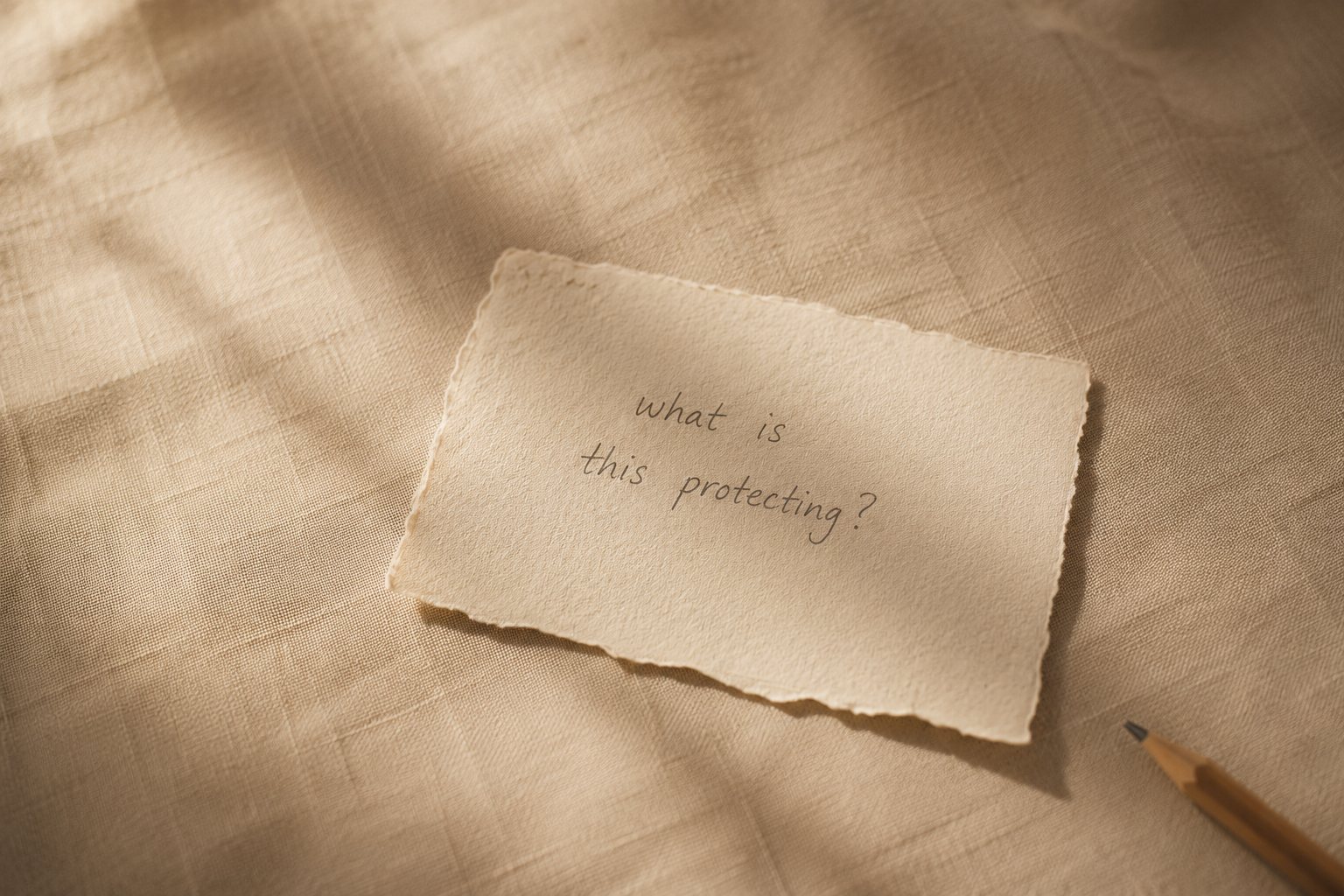
The next time you catch yourself in a pattern, don't ask "why am I like this." That question only ever leads back to the list, and the list makes you the problem. Ask the other question instead: what is this protecting me from right now? Sit with that one for a minute. You're not trying to stop the pattern in that moment, and you're certainly not trying to fix yourself on the spot. You're just learning her, the version of you who shows up when it counts, with a bit of curiosity instead of contempt. Do that a few times and you'll notice something. The protecting starts to feel less necessary the more clearly you can see what it was for.
08The turning point
So this is where the cliché finally earns itself back. Knowing yourself isn't the prize you settle for when change won't come. It's the ground change stands on. You can't redirect something you can't see clearly, and for a long time you couldn't see it. Now you can.
The shift is small and it's everything. You move from "what is wrong with me" to "this protected me once, and it made sense." That's not an excuse. It's the first honest thing you've been able to say about yourself in a while, and it loosens something that's been clenched for years.
The pattern may still turn up. But there's a gap now, between the moment it arrives and the old response that used to follow it automatically. That gap is yours. It's where direction quietly changes, one small choice at a time, long before it ever looks like transformation from the outside. If you want to keep going from here, this is really the work of becoming more self-aware, and if the deeper feeling underneath all this is that you've lost yourself somewhere along the way, there's a gentler way through that too in how to find yourself when you feel lost.
Understanding was never the destination. It was the thing that finally made a different choice possible. You walked in knowing about yourself. You're leaving having started to actually know yourself, which is a quieter thing, and a much bigger one.